
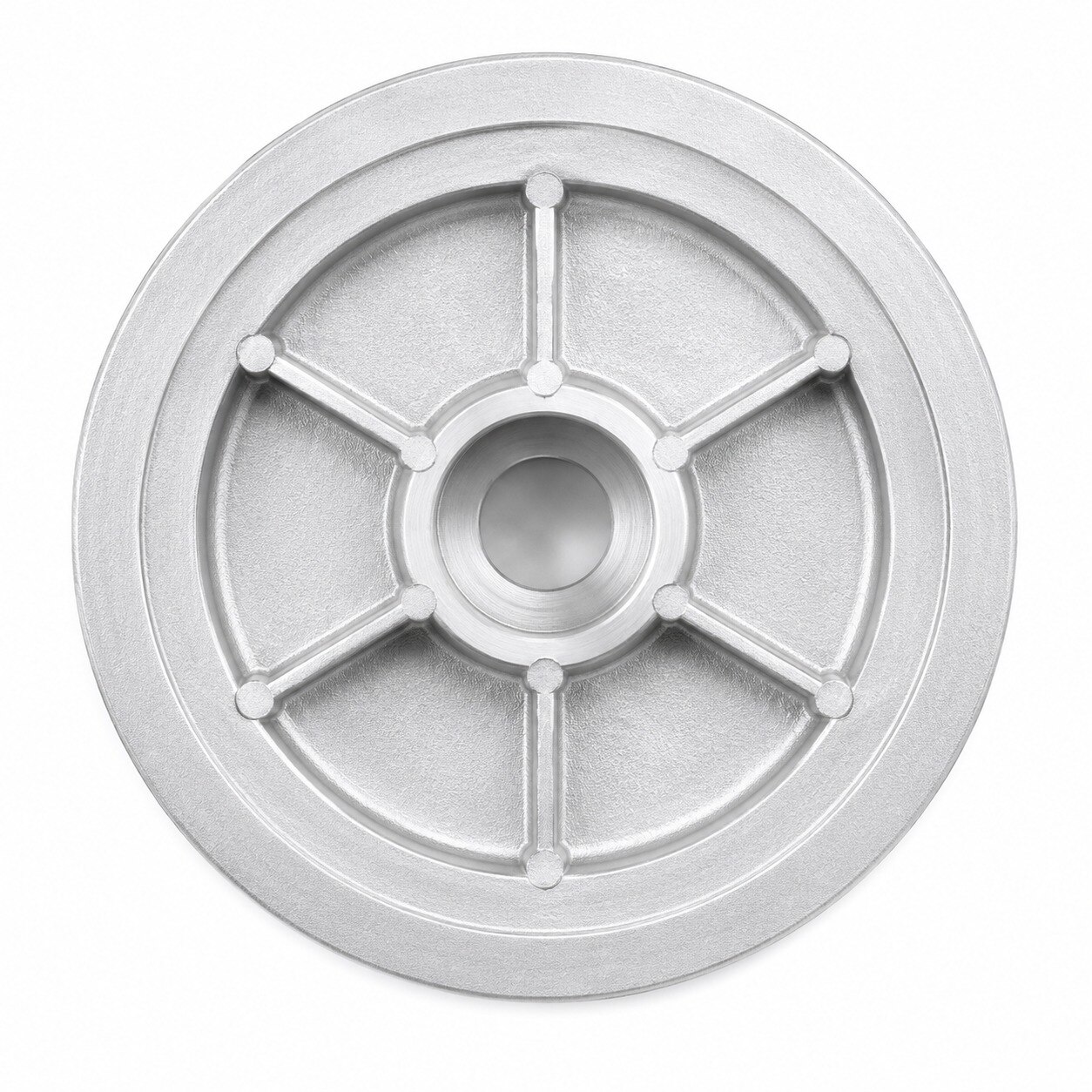
An aluminium piston pulley can fail because of a cracked casting, but misalignment, belt tension, bearing fit, heat, corrosion, and incorrect machining are just as important. By tracing the operating arrangement, failure pattern, and inspection measurements, you can separate a defective component from a machine fault and prevent the replacement from failing again.
Key takeaways
- Check belt alignment, tension and sheave wear before blaming the pulley.
- Match pulley diameter, bore, keyway and load rating to the machine.
- Use fracture location and crack direction to distinguish overload from casting defects.
- Inspect machining surfaces for porosity, tool marks and undersized features.
Start with the pulley’s operating arrangement, not the fracture
A piston pulley for machinery cannot be diagnosed from its broken rim alone. First establish whether it drives a piston mechanism through a belt, forms part of a crank or reciprocating-pump assembly, or is simply a conventional belt pulley mounted near a piston.
That distinction fixes the load direction, reversal frequency, shock level and parts that can create the failure.
- Measure the pulley outside diameter, production bore, hub length and belt-contact width. Record the belt type, belt profile, number of belts and the specified belt tension.
- Trace the power path from motor to pulley, then to the shaft, piston rod, crank or pump. Note whether the pulley carries radial load only or also receives axial force from a misaligned belt.
- Identify the bearing arrangement, shaft fit, key and keyway, fasteners, operating speed and acceleration. A loose key, undersized bearing or off-centre bore can produce eccentric rotation before any fracture appears.
- Record duty cycle and reversals: continuous running, starts and stops, reciprocation, impact loading and idle periods. These determine whether fatigue or shock is plausible.
- Check guarding and nearby heat sources, including engines, brakes and process equipment. Belt slip, bearing friction and heat can change the aluminium hub fit and distort the pulley.
Do not confuse the pulley’s nominal torque rating with its actual service load. Belt alignment, dynamic balance at operating speed and the installed key or hardware complete the operating arrangement; changing any one can turn a sound casting into the visible weak point.
How overload, misalignment and belt faults damage the pulley
The first damaging stress is usually not a fracture; it is a belt force that exceeds the pulley’s radial or axial capacity. Excess tension overloads the rim, hub and bearing, while a sudden start, jammed driven shaft or seized bearing adds a shock load that can crack aluminium at its weakest section.
- Misalignment pulls the belt sideways, creating axial load and concentrating contact on one flange. The result can be flange cracking, belt-edge damage or bearing-seat wear even when transmitted torque remains within the rating.
- A loose bearing, worn shaft or damaged key lets the pulley rotate eccentrically. Each revolution then adds a cyclic belt load, causing vibration, poor tracking and fatigue; static balance alone will not reveal this fault.
- Belt slip creates local heat and polishes, grooves or scores the aluminium surface. Wrong groove angle, pitch diameter, belt profile, wrap or contaminated contact surfaces can cause slip despite apparently correct dimensions.
- Excessive tension magnifies every other fault. It increases bearing friction, shaft loading and hub stress, shortening the time before a crack becomes visible.
Heat reduces the alloy’s strength, changes the bearing fit and degrades lubricant. Belt friction, bearing friction or a nearby hot engine can raise hub temperature enough to create thermal distortion and repeated expansion-contraction damage.
For a piston pulley failure in Mumbai, inspect monsoon water, humidity and chloride exposure around steel-aluminium joints. Corrosion pitting and fretting can start fatigue cracks, but they do not prove a casting defect; replacing the pulley without correcting alignment, fit, tension and speed invites another failure.
Where aluminium casting and machining defects become cracks
An aluminium casting flaw becomes a crack when cyclic belt force reaches a weak, sharp, or overheated area. Aluminium piston pulley casting problems such as gas porosity, shrinkage cavities, cold shuts, oxide inclusions, and inadequate heat treatment reduce the section’s fatigue strength; machining can then expose the defect.
| Location | Typical initiating problem | Resulting failure |
|---|---|---|
| Rim | Porosity, cold shut, thin section, or one-flange loading from belt misalignment | Radial or flange cracks, belt tracking failure, and eventual rim separation |
| Hub | Shrinkage cavity, inclusion, low-strength heat treatment, sharp diameter transition, or thermal cycling | Hub fatigue cracks, eccentric rotation, and loss of shaft location |
| Keyway | Loose key, undersized key, sharp keyway end, or deep machining mark | Keyway deformation and cracks starting at the keyway end |
| Bearing seat | Excessive interference, insufficient interference, fretting, or a scored bore | Hub splitting, bore enlargement, bearing creep, heat, or seizure |
Treat the bearing seat as a fit-and-temperature problem, not only a strength problem. Excessive interference can split an aluminium hub; insufficient interference lets the bearing ring creep and fret the bore. Aluminium expands more than steel, so operating heat changes the fit and can accelerate failure.
Check machining marks at fillets, snap-ring grooves, and abrupt bore changes because they act as fatigue notches. Separate corrosion pitting, fretting marks, and fatigue beach marks from internal casting defects; monsoon water, humidity, chloride exposure, and industrial contaminants can initiate damage without proving a casting fault.ETwitter
How to inspect the failed pulley and identify the root cause
Stop the machine after sudden vibration, belt tracking, guard contact, slipping, seizure, or a temperature rise at the bearing or hub. Photograph the pulley in place, mark its rotation direction, and retain broken pieces; cleaning or grinding can erase the evidence.
For an aluminium piston pulley for problems in mumbai, record monsoon water, chloride exposure, oil, and industrial dust before corrosion is mistaken for a casting defect.
- Measure radial runout, face wobble, bore diameter, shaft diameter, bearing fit, key and keyway dimensions, belt alignment, belt tension, speed, and operating temperature.
- Use a dial indicator against the functional datum, not only a groove micrometer. Compare the readings with the drawing and the machine’s limits.
- Test surface-connected cracks with dye penetrant. Request radiography for suspected internal porosity or shrinkage, recognising that it can miss planar cracks and unfavourable orientations.
| Evidence | Casting defect points to | Installation or operating fault points to |
|---|---|---|
| Fracture surface | Gas pore, shrinkage cavity, inclusion, or cold shut at the origin | Beach marks from cyclic overload, fretting, or a keyway stress concentration |
| Contact surfaces | Internal defect with little external wear | Corrosion pits, polished fretting, bore enlargement, or directional belt wear |
| Geometry and motion | Distortion remaining after correct setup | Eccentric rotation from a loose bearing, worn shaft, damaged key, misalignment, or excessive tension |
Static torque survival does not clear the pulley: aluminium can fatigue under millions of reversals. A repeated once-per-revolution load with correct casting inspection points to the surrounding machine, not automatically the casting.
Choose a replacement by the machine’s evidence, not appearance
Give a casting and machining supplier measured evidence, not a photograph or a matching catalogue shape. For a piston pulley for machinery, provide the alloy and heat-treatment specification, pulley diameter, belt section, production bore and keyway dimensions, shaft fit, operating speed, duty cycle, load direction, temperature, and the failed part’s inspection report.
Include runout, face wobble, bore position, groove profile, crack locations, and the functional datum used for each measurement. SPM Castings can work from that information when a replacement requires both casting control and CNC machining.
- Send the shaft diameter, key dimensions, bearing part number, fit readings, and photographs showing fretting or movement.
- State the actual maximum speed, belt tension, start-stop frequency, shock loads, and nearby heat sources.
- Request dynamic balance at operating speed with the production bore, key, hub hardware, and belt-contact geometry installed.
| Evidence | What it exposes | Acceptance check |
|---|---|---|
| Bore and face measurements against the functional datum | Eccentric machining or casting distortion | Record bore position, radial runout, and face wobble |
| Groove profile and belt alignment | Wrong groove geometry or tracking load | Verify belt seating and parallel shaft axes |
| Fracture and casting inspection | Fatigue, porosity, shrinkage, or surface cracking | Match dye penetrant or radiography to the suspected defect |
Before installation, correct the shaft, bearing fit, belt alignment and tension, operating speed, lubrication, corrosion, and guarding. Otherwise, piston pulley failure in Mumbai can repeat through humidity, monsoon water, chloride contamination, friction heat, or an uncontained belt fault.
Related product
 | Aluminium Gravity Die Castings aluminium die casting refers to a manufacturing process where molten aluminium alloy is injected into a reusable steel mold (die) at high pressure or... View product → |
Frequently asked questions
What should you establish before diagnosing a failed piston pulley?
Identify whether the pulley drives a piston mechanism, belongs to a crank or pump assembly, or is a conventional belt pulley near a piston.
How do overload, misalignment and belt faults damage an aluminium pulley?
Excess load creates rim and hub stress; misalignment causes uneven belt tracking; incorrect tension and worn belts add vibration and cyclic loading.
Where do casting and machining defects become cracks?
Cracks often start at porosity, inclusions, sharp section changes, keyways, bore edges, tool marks or undersized machined surfaces.
How can you identify the root cause of pulley failure?
Record the fracture location, inspect belt and shaft alignment, check tension and bearings, examine the bore and keyway, and compare the pulley with operating evidence.
How should you choose a replacement aluminium piston pulley?
Specify the measured diameter, width, bore, keyway, belt profile, material, balance, speed and transmitted load instead of matching appearance alone.