
Pressure loss, weak suction, cavitation and blocked passages usually come from a mismatch between the Venturi profile, the casting route and the service conditions—not from aluminium alone. By the end, you will know which dimensions to specify, which casting defects to investigate, when to machine the flow path and when another alloy or manufacturing method is safer.
Key takeaways
- Match throat diameter and diffuser angle to the required pressure recovery.
- Inspect porosity, flash, cracks and blocked passages before flow testing.
- Choose aluminium for low weight; choose brass when wear or corrosion demands it.
- Specify alloy, casting route, leak test and internal-passage inspection requirements.
How the Venturi Profile Controls Aluminium Flow
A converging inlet reduces flow area, so velocity rises and static pressure falls under continuity and Bernoulli relationships. At the throat, velocity reaches its design maximum and pressure reaches its minimum; the diffuser then increases area, slows the stream and recovers static pressure.
Recovery is never complete: wall friction, separation and casting roughness create permanent pressure loss.
If your search is for venturi castings for solve aluminium flow problems, check these dimensions before approving the profile:
- Inlet and throat diameters set the area ratio, β = throat diameter ÷ inlet diameter, and therefore the velocity increase and required pressure ratio.
- Throat length must provide a stable measurement or suction zone; a short, rough throat distorts the flow, while an unnecessarily long one adds friction.
- Diffuser angle controls pressure recovery. A steep angle encourages separation and turbulence; a gradual angle needs more length but usually recovers pressure better.
- Specify throat roundness, concentricity with the inlet and outlet, and surface roughness after machining. A cast throat alone rarely gives predictable performance.
- Include upstream and downstream straight lengths in the installation drawing. Elbows, valves and sudden steps near the inlet change the actual discharge coefficient.
| Feature | Flow effect | Dimension to control |
|---|---|---|
| Converging inlet | Raises velocity; lowers static pressure | Inlet diameter, taper and length |
| Throat | Sets peak velocity and minimum pressure | Throat diameter, length, roundness and roughness |
| Diffuser | Slows flow; recovers pressure | Outlet diameter, angle and length |
Diagnosing Pressure Loss, Suction Failure and Venturi Casting Defects
A pressure drop that exceeds the calculated value is not automatically a design failure. Test the finished part with pressure taps upstream and downstream, then compare the measured flow with the drawing’s throat diameter, area ratio and discharge coefficient.
Use this split to locate the cause:
- If several sound, dimensionally correct castings show the same loss or weak suction, suspect the design: inadequate pressure ratio, excessive diffuser angle, insufficient straight length or an undersized throat.
- If one part differs, inspect its bore with a gauge, borescope and coordinate measurement. Core shift, flash, mismatch, rough oxide, a short throat or a blocked passage points to venturi casting defects.
- Turbulence and air entrainment that appear only on castings with rough walls, abrupt steps or a leaking flange indicate surface or dimensional defects. A smooth, concentric bore with the same symptoms indicates the flow design or piping arrangement.
- Cavitation begins when local pressure falls below the fluid’s vapour pressure; listen for crackling and look for pitted metal downstream of the throat. A design pressure problem repeats across good parts, while isolated pits suggest casting porosity or inclusions.
- Use dye or tracer testing to reveal dead zones, and inspect erosion at the throat and diffuser. A localised damaged area can expose porosity; a repeatable pattern signals excessive velocity or poor geometry.
- A probe or borescope identifies blockage directly. Remove the obstruction and retest before blaming “aluminium venture castings problems”; persistent loss after cleaning confirms a design issue.
Measure before modifying the mould or machining every part. That separates aluminium venture castings problems from system problems.
Choosing Aluminium, Brass or Another Alloy for the Flow Path
LM6 aluminium is suitable for a Venturi body when low mass, good thermal conductivity, castability and resistance to ordinary atmospheric or water exposure matter. It is not automatically pressure-tight: specify the casting route, porosity controls, pressure, temperature and fluid before approving it.
Choose another alloy when the fluid attacks aluminium, service temperature exceeds the alloy’s limit, or severe sliding wear governs the throat.
Compare the materials against the same service conditions:
| Material | Weight | Corrosion, wear and machinability | Cost and pressure-tight service life |
|---|---|---|---|
| LM6 aluminium gravity die casting | About 2.6–2.8 g/cm³; the lightest option | Good castability and machinability; adequate corrosion resistance in compatible fluids, but less wear and galling resistance than brass | Usually favourable for low-to-medium volumes; reliable life depends on low porosity, sound cores and leak testing |
| Brass gravity die casting | About 8.3–8.7 g/cm³; roughly three times heavier | Better thread durability, wear and galling resistance; machines well, but check dezincification and fluid compatibility | Higher material cost and mass can reduce value brass GDC offers; a sound casting can provide longer life in abrasive or threaded service |
| Another approved alloy | Depends on grade | Select for a defined temperature, chemical or wear requirement | Compare total casting, machining, inspection and replacement cost—not alloy price alone |
For pressure service, compare leak-test results and failed-part history rather than tensile strength alone. A porous high-strength aluminium casting can outlive neither a sound LM6 casting nor a brass one; pressure-tight life depends on the casting process, wall thickness, machining damage and corrosion allowance.
Selecting the Casting Route and Protecting the Internal Passage
Choose gravity die casting for low-to-medium volumes, larger aluminium sections and lower tooling cost than high-pressure die casting. Use sand casting when geometry, size or low volume makes permanent tooling uneconomic; choose shell-core casting when the throat needs a stiffer, smoother, more accurate removable core.
Use CNC machining when the passage is short, accessible and dimensional control matters more than casting cost.
| Route | Choose it when | Passage consequence |
|---|---|---|
| Gravity die casting | Repeated production with moderate volumes | Good surface and strength, but plan for parting-line evidence and machining |
| Sand casting | Large, complex or low-volume bodies | Flexible tooling, but greater roughness, draft and core-shift risk |
| Shell-core casting | A stable internal profile is critical | Better core accuracy and finish than ordinary sand, with higher tooling effort |
| CNC machining | The bore is accessible or casting tolerance is inadequate | Highest control of throat diameter, roundness and concentricity, but solid stock and tool access are required |
Support the core at defined locating points, not only at its ends. Ask for a method that verifies core position before pouring; an attractive casting tolerance cannot reveal eccentricity after the core has moved. Provide inspection access at the throat and transitions, where a small shift changes effective area sharply.
- Vent the core so trapped gas does not create blowholes or block the passage.
- Gate aluminium so the throat is not the last, coldest region to fill; poor filling causes cold shuts, misruns and inclusions.
- Add feeders and overflow capacity where needed, then remove gates, flash and core material without narrowing the bore.
- Machine the throat and sealing faces to drawing datums, and inspect for mismatch, ovality and residual sand before assembly.
What to Specify When Sourcing Aluminium Venturi Castings in Pune
Require a controlled drawing and process plan before comparing aluminium Venturi castings in Pune. State the alloy or approved equivalent, casting route, maximum envelope, fluid, pressure, temperature, pressure ratio, and whether the body must remain pressure-tight after machining.
- Specify inlet, throat and outlet diameters, throat length, concentricity, diffuser angle, flange faces, wall thickness and datum scheme.
- Define machined tolerances, surface-finish limits for the throat and passage, draft, flash limits and permitted core mismatch.
- Name the leak-test method, test pressure, hold time and acceptance criterion. Choose hydrostatic testing for compatible liquids; use pneumatic testing only with a documented safe procedure.
- Require a porosity-control plan covering feeder design, section transitions and inspection of the throat, bosses and flange junctions. Ask whether radiography, computed tomography or sectioning applies to critical zones.
- Tie each casting to an alloy heat or melt number, casting batch, core batch, machining program, operator and inspection date.
| First-article check | Evidence to require | Failure it exposes |
|---|---|---|
| Dimensional inspection | CMM report for throat, bores, concentricity and flange datums | Flow-area error or core shift |
| Leak test | Signed pressure-versus-time record | Interconnected porosity after machining |
| Passage inspection | Borescope photographs or sectioned sample | Flash, sand, blockage or roughness |
| Traceability review | Material and process records linked to serial number | Unrepeatable replacement parts |
Treat dimensional approval and pressure approval as separate gates. SPM Castings can be evaluated on the same evidence: a first article, not a catalogue description, proves whether its casting and CNC route hold the Venturi geometry.
Related product
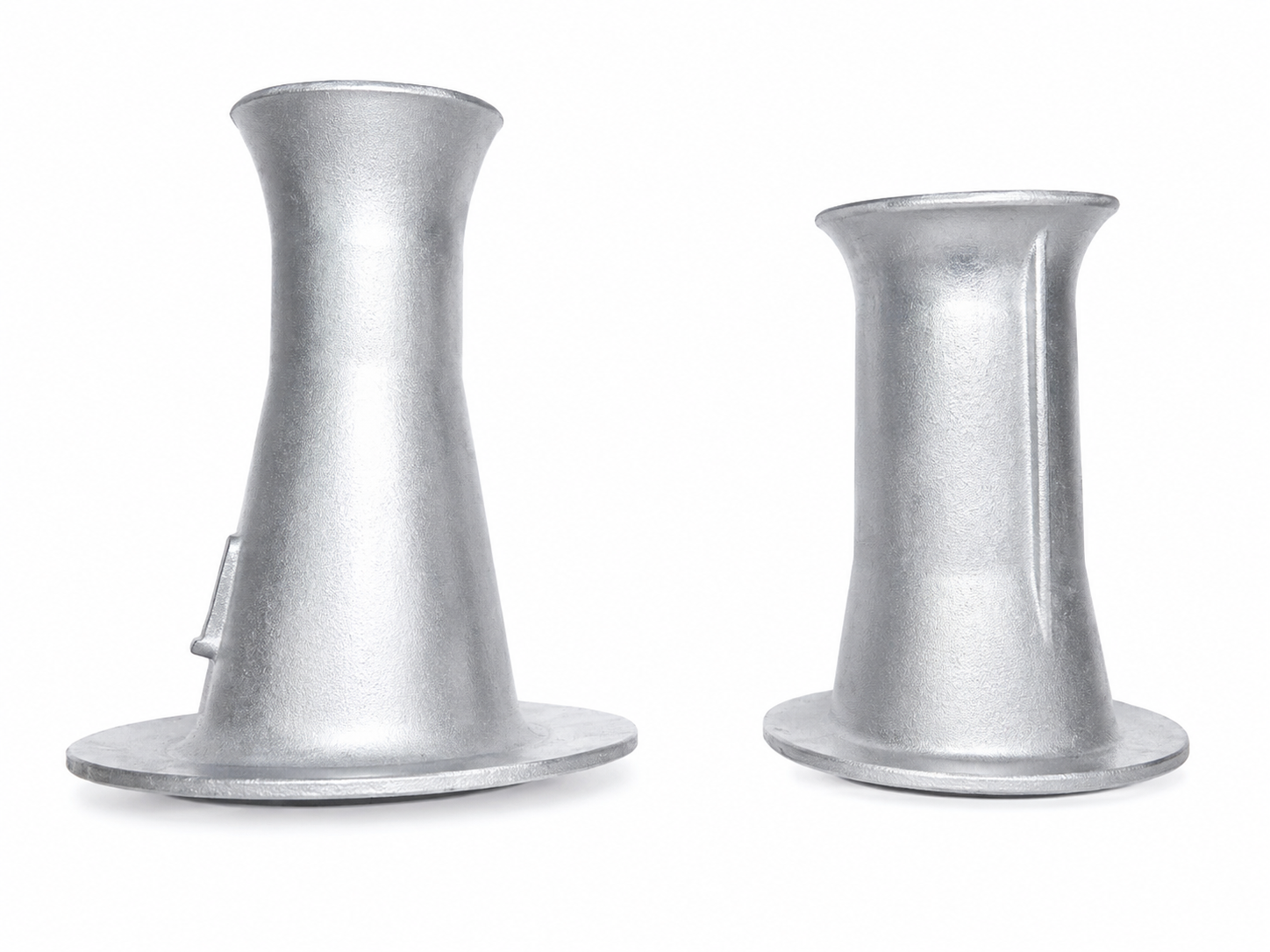 | Aluminium Gravity Die Castings Aluminium Gravity Die Castings in LM6 Material View product → |
Frequently asked questions
How does a Venturi profile control aluminium flow?
The converging inlet increases velocity and lowers static pressure at the throat. The diffuser then reduces velocity and recovers pressure as the passage expands.
What causes pressure loss and suction failure in a Venturi casting?
Incorrect throat dimensions, rough surfaces, abrupt transitions, blocked passages, leakage and excessive porosity can reduce pressure recovery or suction.
Which alloy is better for a Venturi flow path: aluminium or brass?
Aluminium suits applications prioritising low weight and corrosion resistance. Brass suits flow paths needing greater wear resistance, machinability or compatibility with demanding fluids.
Which defects should you check in aluminium Venturi castings?
Check for porosity, shrinkage cavities, cold shuts, flash, cracks, dimensional errors and core shifts that narrow or obstruct the internal passage.
What should you specify when sourcing aluminium Venturi castings in Pune?
Specify the alloy, throat and passage dimensions, surface-finish limits, casting process, machining datums, leak-test pressure, inspection method and documentation.