
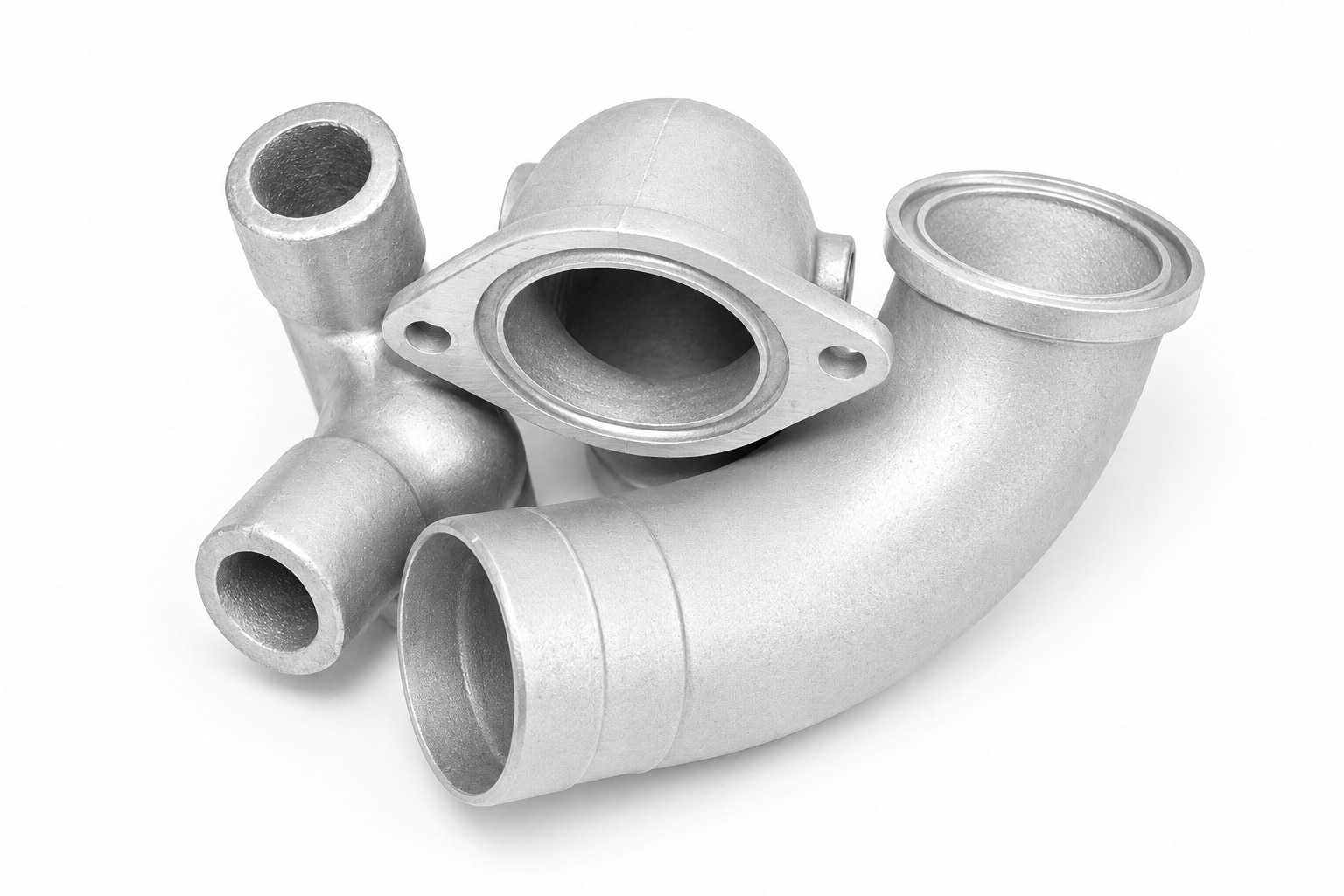
An aluminium pipe casting cannot be specified safely by nominal size alone. Before requesting a quotation, define the service medium, pressure and temperature, finished dimensions, alloy, casting process, inspection method and acceptance limits so the supplier can price a reproducible part rather than guess from a sample or catalogue name.
Key takeaways
- Use casting when integrated bosses or complex shapes justify solidification-risk control.
- Put finished geometry, datums, wall thickness and machining allowances on the drawing.
- Name the alloy, temper, pressure test and internal-defect acceptance limit.
- Compare quotes using identical tooling, inspection, machining and rejection assumptions.
Decide Whether a Cast Pipe Fits the Service
A cast pipe fits the service when its shape or integrated bosses justify casting, and when you can control the risks of solidification defects.
Unlike an extruded or drawn tube, welded pipe, forged part, or pipe machined from solid, an aluminium pipe casting forms its hollow geometry during pouring and can contain gas porosity, shrinkage cavities or oxide films.
1. Record the medium: water, oil, coolant, air, hydraulic fluid or chemicals. State operating and peak temperature, then classify the part as pressure-containing, vacuum-rated, structural or only a housing.
2. Define the pressure basis if containment matters: minimum wall after machining, allowable pressure, test pressure, design safety factor, leakage limit and cyclic duty. Nominal wall thickness alone is not a pressure rating.
3. Name the process in the purchase document. “Aluminium castings” or “pipe casting” is too vague.
| Process | Wall, finish and defects | Best fit |
|---|---|---|
| Sand casting | Flexible geometry and thicker walls; rougher finish, lower repeatability and higher defect risk | Low volume or complex housings |
| Gravity or permanent-mould casting | Better finish and repeatability than sand; moderate volume and controlled wall sections | Repeated industrial parts |
| Low-pressure casting | Cleaner filling and sounder sections; suited to repeat production | Pressure-related cast components |
| Centrifugal casting | Dense tubular sections and consistent walls; limited geometry | Round sleeves and straight tubes |
| Extrusion or seamless/drawn tube | Thin, uniform walls, smooth bore and high repeatability; long straight lengths | Long, straight aluminium pipe |
Choose extrusion or seamless tube when the pipe is long, straight and uniform-wall. Choose casting when ports, flanges, bends or bosses are integral. Test pressure or leakage after machining if bores or sealing faces could expose hidden defects.
Put the Finished Geometry and Datums on the Drawing
A supplier cannot quote an aluminium pipe accurately from nominal size alone. Put the finished outside diameter, inside diameter, minimum wall thickness, overall length, straightness and concentricity on the controlled drawing.
| Nominal pipe size | Actual drawing requirement | Why it matters |
|---|---|---|
| Nominal size | Reference designation only | It does not define the cast bore or outside diameter |
| Finished dimensions | Measured outside diameter, inside diameter and minimum wall | It controls fit, flow area and pressure boundary |
Show whether each dimension applies before or after heat treatment. State the drawing units, revision, inspection points and machining allowance for every surface; excessive stock increases cost and distortion, while insufficient stock can leave casting skin or expose porosity.
Include end geometry, flange thickness, face runout, bosses, threaded or machined ports, port locations, bolt-circle diameter and hole data, blend radii, and every sealing surface. Give separate tolerances for bore size, wall eccentricity, straightness, flatness, runout, coaxiality and machined faces. “Standard casting tolerances” cannot control these features.
Use a datum scheme: primary datum A as the flange face, datum B as the bore axis, and datum C as a clocking key or port. This makes port position and coaxiality measurable.
- State whether the pipe is cast, machined or both, and identify all pressure-boundary surfaces.
- Select ISO 2768 for suitable general dimensions, ASTM B26/B26M or ASTM B85/B85M for the applicable route and alloy family, EN 1676 where applicable, or an agreed customer specification.
For aluminium pipe casting specifications in Chhatrapati Sambhajinagar, the same detail is essential; “pipe casting as per sample” is not reproducible.
Confirm the Alloy, Temper and Castable Design
Name the alloy designation and temper separately. Do not accept “6061 aluminium pipe casting” without clarification: 6061 is primarily a wrought alloy, not a conventional casting grade.
| Alloy | Tensile and yield strength | Corrosion, weldability and pressure-tightness |
|---|---|---|
| A356 or A357 type | Heat-treatable; compare the required T6 tensile and yield targets with the supplier’s certificate | Strong choice for pressure-capable aluminium castings; assess corrosion exposure, ductility and weld repair limits |
| A380 | Good castability and common for complex shapes; verify tensile and yield values for the actual process | Lower ductility and different corrosion and welding behaviour require caution in pressure service |
| Other Al-Si alloys | Use the exact designation and temper data, not a family name | Compare ductility, corrosion resistance, weldability, porosity risk and leak performance against the service |
State whether T6 treatment is required, including quench and ageing conditions, minimum tensile and yield strength, and elongation. Inspect critical dimensions after treatment because quenching can move the part and heat treatment can expose interconnected porosity.
Review external and core surfaces for draft. Require uniform wall thickness, generous fillets, gradual boss-to-wall transitions and suitable internal radii; sharp changes create hot spots and shrinkage.
Ask the supplier to mark the parting line and identify core supports, vents, risers and hot spots. Specify machining allowance surface by surface: too little leaves skin or porosity, while too much increases removal, distortion and cost.
Ask how shrinkage, trapped air and core movement will be controlled. Confirm whether the test coupon is attached, cut from representative production material or separately poured; a separate coupon can give misleading results.
Define Pressure, Leakage and Internal-Defect Acceptance
1. Set the pressure basis for the finished pipe casting: design pressure, peak and operating temperature, minimum wall after machining, design safety factor, service fluid and required cyclic-duty life. Add the vacuum rating, collapse limit and pressure-cycle count when the aluminium pipe sees vacuum or repeated transients.
2. Define the test method in numbers. State test pressure, medium, temperature, hold time, allowable leakage in mL/min or bubbles per minute, and the acceptance rule for pressure loss. Use hydrostatic testing when service and cleanliness requirements permit it.
Pneumatic testing with air or another gas stores far more hazardous energy, so agree the procedure, enclosure, exclusion zone, relief devices and controls before testing.
3. State whether testing occurs before or after final machining. Machining can open subsurface porosity at bores, threaded ports and sealing faces, so a rough-casting test cannot replace a finished-part test.
Separate visual and dimensional inspection, leak or pressure testing, and radiography or computed tomography; imaging can find shrinkage and gas porosity but cannot prove leak-tightness.
4. Name the governing requirements, such as ASTM B26/B26M for sand castings, ASTM B85/B85M for die castings, EN 1676 where applicable, and ASME BPVC Section VIII or ASTM E1003 for the pressure-test basis. Write measurable limits for each. If impregnation is allowed, name the process and require disclosure: sealed porosity is not defect-free metal.
Specify packaging and cleanliness limits for hydraulic fluid, coolant or other contamination-sensitive service, and identify the applicable alloy and temper for the aluminium castings.
Make the Quotation Comparable Before You Place the Order
A comparable quote begins with an identical information pack. For aluminium pipe casting specifications in Chhatrapati Sambhajinagar, send SPM Castings and every competing supplier:
- Controlled drawing, 3D model if available, alloy and temper, named casting process, annual quantity and batch size
- Machining operations and datums, heat-treatment condition, inspection plan and pressure-test procedure
Request the as-cast stock condition alongside finished dimensions, material certificate, heat-treatment record, dimensional report, leak-test result and traceability from melt or batch number to parts. Ask whether test coupons are separately poured, attached to the casting or cut from production-representative material; a separately poured coupon can hide porosity or cooling-rate differences.
| Quotation item | What to compare | Why it matters |
|---|---|---|
| Tooling and cores | Die, pattern, core-box and core charges | Exposes costs hidden outside the pipe price |
| Machining | Datums, allowances and operations | Prevents different assumptions about finished geometry |
| Quality | Inspection, certificates, impregnation disclosure and rejection handling | Defines who proves compliance and pays for failures |
| Delivery | Packaging, cleanliness and lead time | Links price to usable, scheduled parts |
Approve the first article only after checking minimum wall thickness, bore, flange alignment, port position, heat-treatment condition and the required pressure or leak test. Location does not replace an alloy designation, process requirement or measurable acceptance limit.
Related product
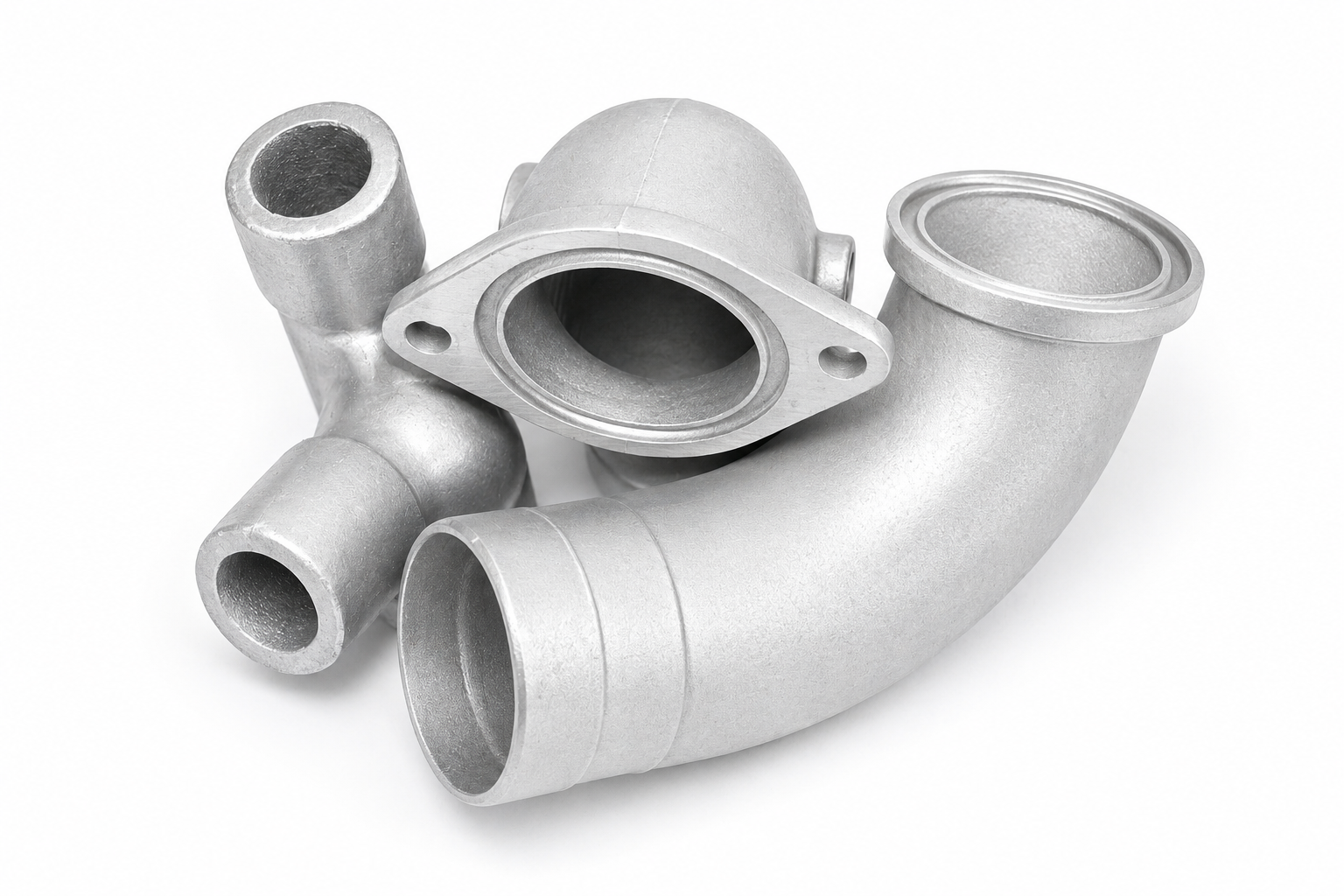 | Aluminium Gravity Die Castings Pipe Pipe |
Frequently asked questions
When does an aluminium pipe casting fit the service?
Choose a cast pipe when its shape or integrated bosses justify casting and you can control solidification defects. Use another process when the design is a simple constant-wall tube or demands defect control beyond the casting route.
What must the drawing specify for an aluminium pipe casting?
Show finished geometry, wall thickness, bosses, machining allowances, datums, tolerances, surface requirements and all critical interfaces. Identify which dimensions apply before and after machining.
How should you define pressure, leakage and internal-defect acceptance?
State the pressure-test medium, test pressure, hold time, allowable leakage and repair policy. Define inspection methods and rejectable indications, such as radiographic porosity, shrinkage cavities or cracks.
How can you compare aluminium pipe casting quotations fairly?
Give every supplier the same drawing, alloy and temper, production quantity, tooling scope, machining requirements, inspection plan, pressure test and defect limits. Separate one-time tooling charges from the recurring casting and machining price.